Whostory: A daily history guessing game
Made by SparkGame. Free, no sign-up; your results stay in this browser.
Whostory is a free daily history guessing game by SparkGame: name five famous figures from three AI-painted clue scenes each, and spend your points on their collectible cards.
What is Whostory?
Whostory is a free browser game made by SparkGame in which you name famous people from history. Each day brings five figures, and each one hides behind three painted clue scenes that open ten seconds apart: a place, an object or a moment from their life, never their face. Name the person in time and you score points, faster for more; spend the points in the card cabinet to collect the figures you have met, from Common cards to Legendary ones.
How Whostory works
A daily round is five figures, the same for everyone, and changes at midnight UTC. For each figure the first clue scene appears at once, the second after ten seconds and the third after twenty; the clues go from a little-known detail of the person's life to the thing most people know them for. You have 30 seconds and two guesses. The guess box suggests names as you type from a list of about a thousand historical figures, so the suggestions do not give the answer away. A first guess is worth 100 points minus about three points for every second you take, never less than 20; a right second guess is worth half that, and two wrong guesses or running out of time scores 0. After each figure you see who it was, their dates, a one-line summary and the true fact behind each clue, with a link to the source. Practice rounds deal five other figures whenever you like and pay half their score into your points. Points buy cards for the figures you have met: Common, Rare, Epic and Legendary cards cost 100, 300, 800 and 2,000 points.
How to play Whostory, step by step
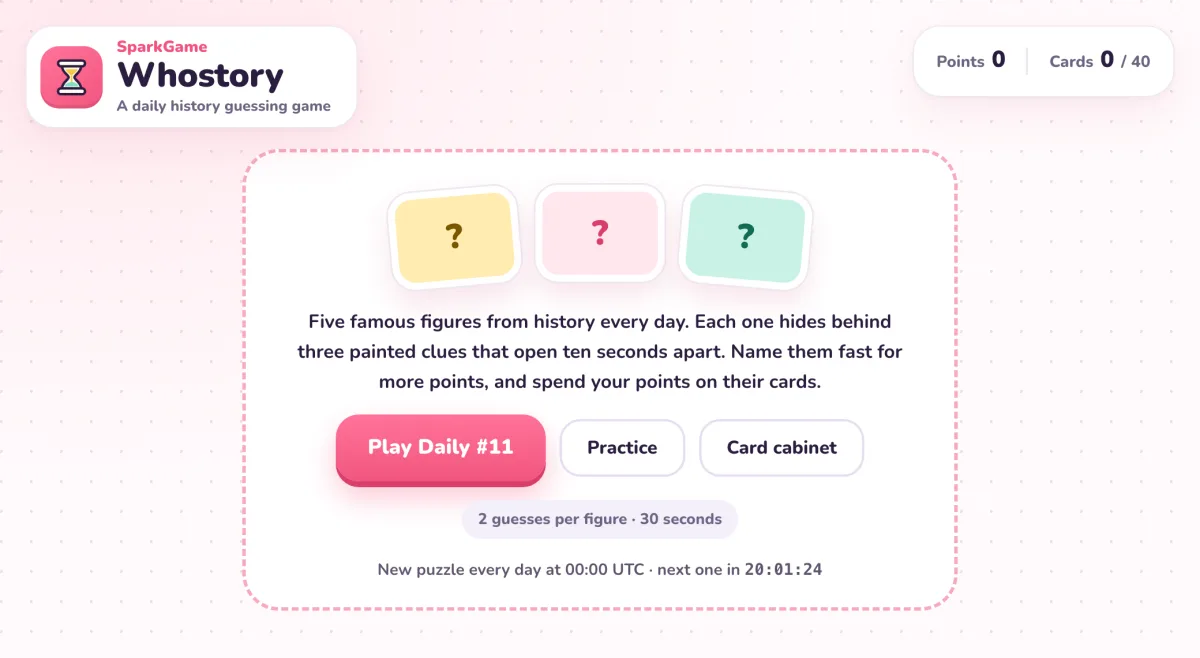
1. Start today's round, a practice round, or open your cards
Open Whostory and press Play Daily for the five figures everyone gets today, Practice for five others, or Card cabinet to see the cards you own. Your points, your cards and today's progress are kept in your own browser, so there is no account to make.
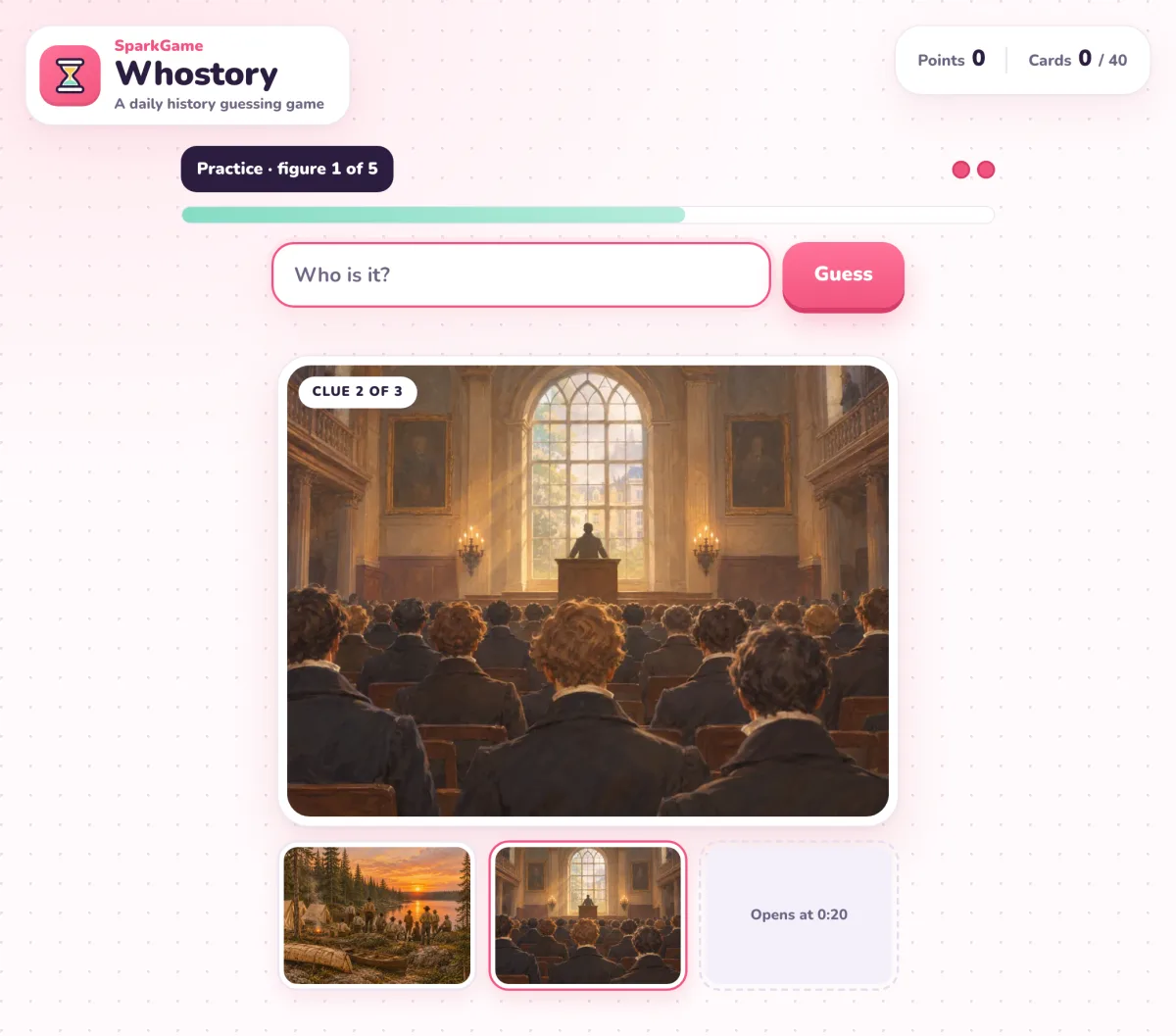
2. Study the clues as they open
The first painted clue appears at once in a white frame. The second opens after 10 seconds and the third after 20, and you can switch between the ones already open. Early clues show a lesser-known moment from the person's life; the last one shows what they are famous for.
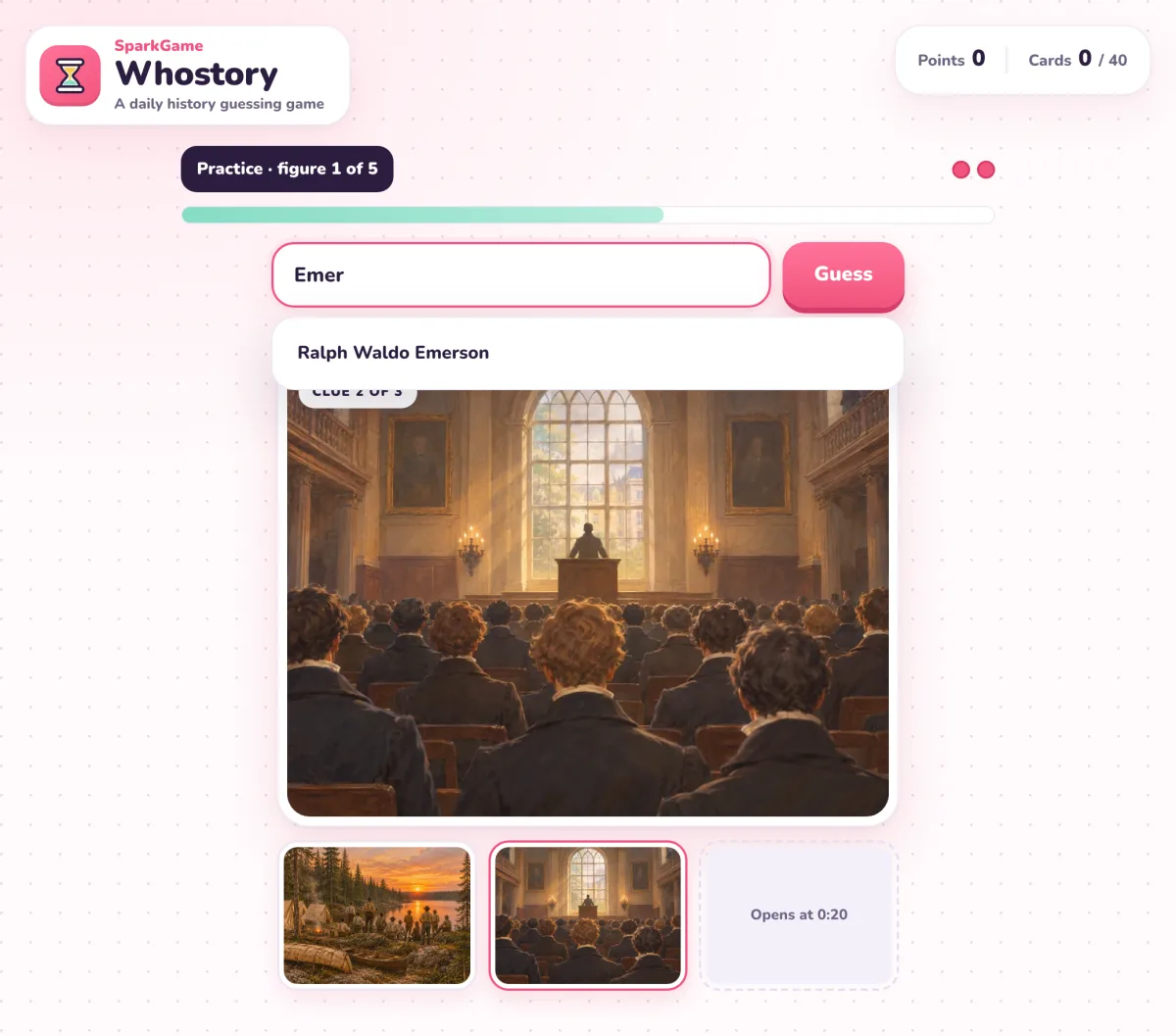
3. Guess the figure
Type a name and pick it from the suggestions, or press Enter. You have two guesses and 30 seconds. Spelling slips and common alternative names count, so Bonaparte works for Napoleon. Answer early for more points: the score drops by about three points a second.
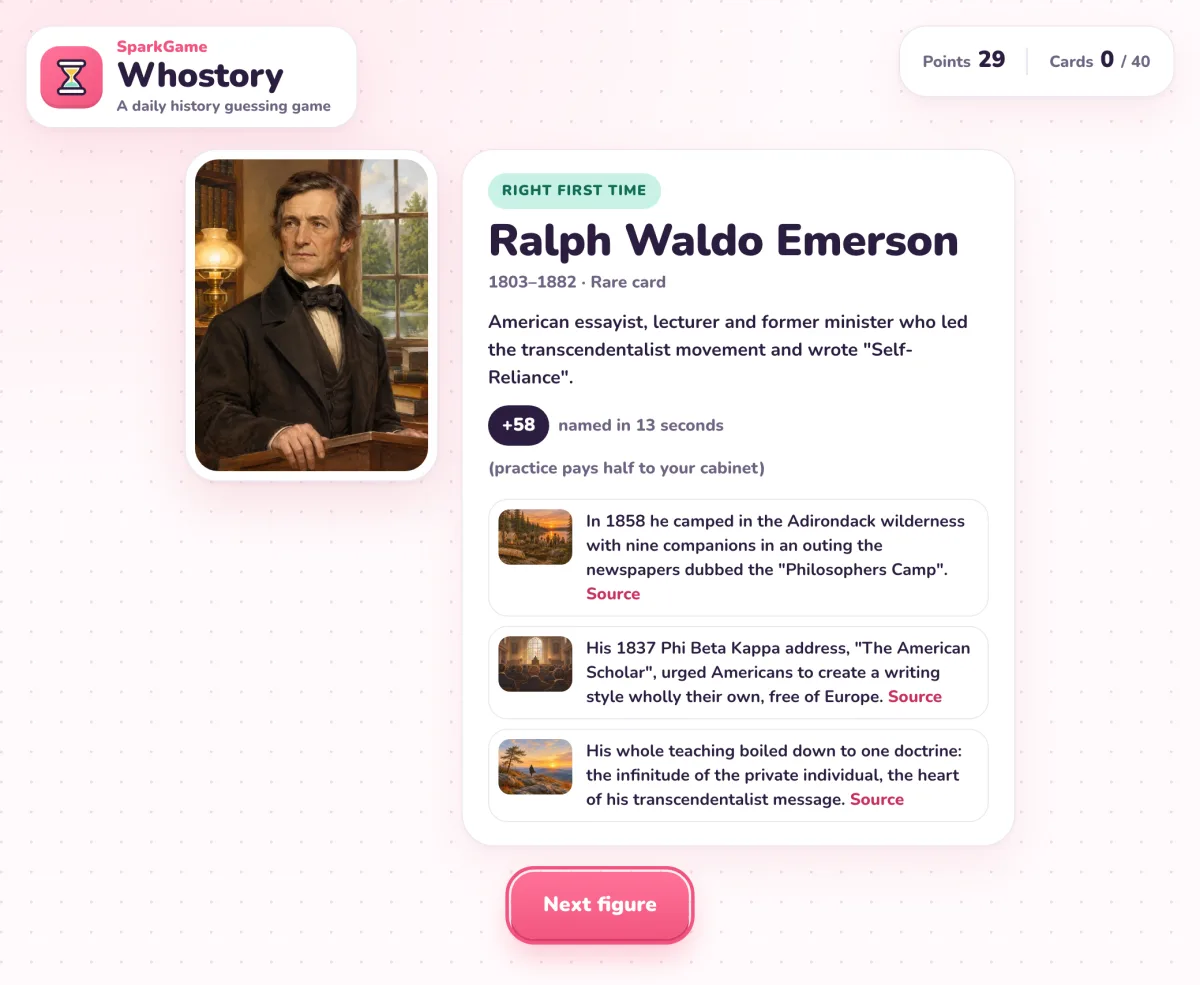
4. Read the reveal, then collect the card
Each reveal shows the figure's painted card portrait, dates and the true story behind every clue, with a link to the source. After five figures you get your score out of 500 and a line of coloured squares to share. Spend your points in the card cabinet to unlock the cards of the figures you have met.
Scoring at a glance
| When you name the figure | First guess | Second guess |
|---|---|---|
| After 3 seconds | 90 | 45 |
| After 10 seconds | 67 | 34 |
| After 20 seconds | 33 | 17 |
| After 27 seconds | 20 | 10 |
| Two wrong guesses, or time runs out | 0 | 0 |
A daily round is 5 figures, so the maximum is 500. A right answer is never worth less than 20 on the first guess. Practice rounds pay half their score into your points. Cards cost 100 (Common), 300 (Rare), 800 (Epic) and 2000 (Legendary) points. The squares in your shared result mean: 🟩 a fast first guess (70 points or more), 🟨 any other first guess, 🟧 the second guess, ⬛ missed.
How to score higher in Whostory
Read the first clue for era and place
Before you think about who, work out when and where: the clothes, buildings, ships and tools in a scene narrow the field fast. The bank covers 4 regions of the world, from 1303 BC to people who died as late as 1948.
Answer as soon as you are fairly sure
Every second costs about three points, and a wrong first guess only halves your score, so a confident guess at 8 seconds usually beats a certain one at 25.
Keep the second guess for the last clue
If your first guess is wrong, wait for the next clue before using your second one. The last clue always shows what the person is best known for.
Use the suggestions
The guess box suggests from about 1,072 names, so typing the first few letters of a surname is enough. The suggestions never narrow down to the answer, so treat them as spelling help, not hints.
Play practice rounds for points
Practice pays half its score, but you can play as many rounds as you like. The bank holds 40 figures, 10 of them Legendary, and a card only unlocks once you have met that figure in a round.
Numbers on this page are counted from the game's own bank of 40 figures.
Where the figures and clues come from
The figures come from Wikipedia's list of vital articles about people, about 2,000 of the most important people in history as chosen by Wikipedia editors. Whostory keeps only people who died before 1950, leaves out religious founders and prophets and a few especially divisive political figures, and balances fields and regions so that at least a third of the figures come from outside Europe. A figure's card rarity follows how many language editions of Wikipedia have an article about them.
Each clue states a fact taken from the figure's own English Wikipedia article. The clues were drafted with an AI model, and every one had to quote the sentence it rests on; a clue whose quote is not in the article was thrown out. The scenes were painted with OpenAI's GPT Image 2 and checked for writing, faces and historical mistakes, and the faulty ones repainted. Paintings can still get small details wrong, which is why each reveal links to the source.
Whostory vs similar games
WenWare, made by @underpaid_mom at wen-ware.com, also turns AI-painted history into a guessing game: it drops you into a 360° scene and asks where and when it happened. Whostory asks who: three painted scenes from one person's life, and a name to find. If you like reading a scene for clues in WenWare, the same eye for clothes, buildings and objects helps in Whostory.
Classic "Who am I?" history quizzes give written clues one at a time. Whostory gives painted ones instead, adds a 30-second clock and keeps score with points and collectible cards.
Our guides to the games it is compared with: WenWare.
Game info
| Made by | SparkGame |
|---|---|
| Daily #1 | Nov 8, 2026 |
| New daily | 00:00 UTC every day |
| Figures | 40 in the bank, 5 per round, 30 seconds each |
| Price | Free, no account |
| Last updated | Nov 8, 2026 |
Whostory FAQ
- Is Whostory like WenWare?
- They share an idea, AI-painted history you have to read for clues, but ask different questions. WenWare shows a 360° scene and asks where and when it happened; Whostory shows three scenes from one person's life and asks who it was. Whostory is made by SparkGame and is not affiliated with WenWare or its creator.
- How many figures are in Whostory?
- The bank holds 40 figures today, 19 of them from outside Europe, and more are added in batches. Each daily round uses five of them.
- How is Whostory scored?
- A right first guess is worth 100 points minus about three points for every second you take, never less than 20. A right second guess is worth half that. Two wrong guesses or running out of the 30 seconds scores 0. Five figures make a maximum of 500.
- When does the Whostory daily change?
- At midnight UTC: 7 pm in New York and 4 pm in Los Angeles until US clocks go forward on March 14, 2027, then 8 pm and 5 pm. Practice rounds are not tied to the daily, so you can play them any time.
- Are the paintings historically accurate?
- Each painting is based on a fact from the figure's Wikipedia article and was checked for writing, faces and obvious historical mistakes, but an AI painting can still get small details wrong. The reveal after each figure states the real fact behind every clue and links to its source.
- How do the cards work?
- Every figure you meet in a round can be unlocked as a card with your points: Common cards cost 100, Rare 300, Epic 800 and Legendary 2,000. Rarity follows how famous the figure is, measured by how many language editions of Wikipedia write about them. Owned cards show the figure's portrait and a fun fact.
- Do I need an account, and are my points saved?
- No account and no download. Your points, cards and daily progress are kept in your own browser's storage and never sent to us, so they stay on this device and disappear if you clear your browser data.